Our annual statistical bulletin, the Irish Maritime Transport Economist is a comprehensive reference guide to maritime transport statistics, including; trade, traffic, international shipping markets and economic data.

The Irish Maritime Development Office publishes the Irish Maritime Transport Economist in April of each year. This publication is a statistical bulletin and a comprehensive source of national maritime traffic, trade and global shipping market data. The Irish Maritime Transport Economist provides an in-depth retrospective analysis of maritime freight volumes, cargoes and passenger freight volumes.

The publication provides a valuable descriptive statistical analysis for the maritime industry on the dynamic relationship between the national ports, the shipping sector and the Irish economy. Maritime traffic handled by the Northern Irish ports is also included in the annual research as the Irish Maritime Transport Economist reflects the economic impact of maritime passenger and freight traffic from an all island perspective.

The archive of the Irish Maritime Transport Economist carries annual statistics and analysis from 2004 onwards. The archive provides an insight on national port performance and maritime freight and passenger activity.

Please note that any information that is reproduced from the Irish Maritime Transport Economist must be referenced back to the Irish Maritime Development Office.

Irish Maritime Transport Economist 2026 (Volume 23)

Document Thumbnail

2025 was an extraordinary year for international maritime trade. Ireland’s ports and shipping companies operated in an environment of increased geopolitical tension, logistical disruption, and significant policy
development. As a result, decisions affecting trade flows and capacity were shaped as much by external circumstances as by underlying domestic demand.

The relevance of these developments for Ireland is clear. In a highly trade-dependent island economy, disruption to global trade has a direct bearing on the cost, competitiveness and resilience of the seaborne services on which the economy relies. Against this backdrop, it is appropriate to take stock of Irish trade flows and the port infrastructure that supports them. This report provides that assessment, identifying how global influences, domestic demand and structural change interacted across Irish trade flows and port activity in 2025.

With a trade-to-GDP ratio of 246%, Ireland remains one of the most trade-dependent economies in the world and is therefore particularly exposed to shocks in global trade and consequential impacts in shipping and energy markets. As approximately 90% of traded goods by volume move by sea, the performance and resilience of Ireland’s maritime sector are of strategic importance to the national economy.

Despite these pressures, an overarching theme of recent IMTE publications has been one of resilience. At the midpoint of the decade, Irish trade has already weathered the pandemic, the end of the Brexit transition period, the Russian invasion of Ukraine and the temporary closure of Holyhead, each of which placed significant pressure on trade flows and supply chains. Continued population growth, changing trade patterns, the rising share of unitised freight and the energy transition are placing new demands on our maritime industry, highlighting the importance of capacity provision, operational efficiency and long-term infrastructure planning.
 

File Source
Thumbnail
Document Thumbnail

Irish Maritime Transport Economist 2025 (Volume 22)

Document Thumbnail

The Irish Maritime Development Office (IMDO)’s iShip index grew by 2% following a sharp decline in 2023. This was driven in part by a rise in bulk traffic through our ports, particularly dry bulk, where seven out of nine dry bulk ports recorded growth. In the liquid bulk market, volumes declined by 8%. However, this was driven almost entirely by a fall in exported products. Ireland’s dependency on imported liquid bulk products, such as transport fuel and home heating oil, remains remarkably stable. For ten consecutive years, Ireland has imported approximately 9 million tonnes of liquid bulk goods, with variation of just 4% on average over that time. This shows a consistent demand pattern in the Irish economy for oil-based products, the majority of which is consumed by the transport sector.

There were mixed results in the Roll-on/Roll-off (RoRo) and Lift-on/Lift-off (LoLo) sectors, collectively referred to as the unitised, or containerised sector of Irish port throughput. RoRo traffic declined slightly, by 1% in 2024, following on from a 2% decline recorded in 2023. These modest declines are not attributable to a particular port or route. Rather, trend analysis undertaken by the IMDO using its long-standing time series of port throughput shows that volumes in this sector have plateaued and possibly entered a period of slight contraction. This is at odds with trends in the LoLo sector, where volumes reached record highs in 2024, increasing by 10% and averaging more than 100,000 Twenty-foot equivalent units (TEU’s) per month for the first time. This is consistent with the performance of global seaborne container trade, which grew by 6% in 2024. The volume of container traffic through the key European hub ports of Rotterdam and Antwerp grew by 8% and 3% respectively, adding approximately 1 million TEU’s of throughput when combined.

The impressive growth in the Irish LoLo sector in 2024 represents a strong rebounding, as it follows a 5% decline in 2023- driven by a steep rise in global inflation. It will come as a welcome sign then, that inflation in Ireland and across Europe declined significantly in 2024. The rate of goods inflation in Ireland, which excludes services and is more relevant to importers and exporters of merchandise goods, decreased in 2024, with prices 1.5% lower than a year earlier, as measured by Harmonised Index of Consumer Prices. Across the European Union (EU), goods disinflation was recorded, falling from 6.9% in 2023 to 1.3% in 2024. Alongside these encouraging metrics were positive economic growth figures both domestically and in the economies of our largest trading partners. Irish modified domestic demand remains robust, growing by 2.7% in 2024. In both the UK and EU economies, real GDP grew by 1% each, while real GDP in the United States grew by 2.8%.

Domestic and foreign demand patterns are key predictors of Irish port throughput, especially in the containerised sector, which handles mainly manufactured goods, and such growth underpinned the rise in container traffic at Irish ports in 2024.

There were further encouraging developments in 2025 with the announcement of a new agreement between the EU and the UK in May. This marked a constructive step toward improving trade conditions with Great Britain, Ireland’s largest maritime trading partner. More than one third of all Irish port traffic involves ports in Great Britain, underlining the importance of this relationship. A central feature of the agreement was the reform of Sanitary and Phytosanitary (SPS) measures, reducing complexity in inspections and documentation. These changes are particularly advantageous for Irish agri-food exporters, easing logistical challenges and enhancing market access.


Liam Lacey, Director of the IMDO, commented; “I would like to extend my sincere thanks to everyone working across the maritime transport sector for their essential role in maintaining and strengthening Ireland’s international trading relationships. Your efforts continue to support economic growth, enhance efficiency, and promote national competitiveness. I would also like to thank all those who contribute to and engage with this publication. Your support and input are vital to its continued value and impact.”


File Source
Thumbnail
Document Thumbnail

Irish Maritime Transport Economist 2024 (Volume 21)

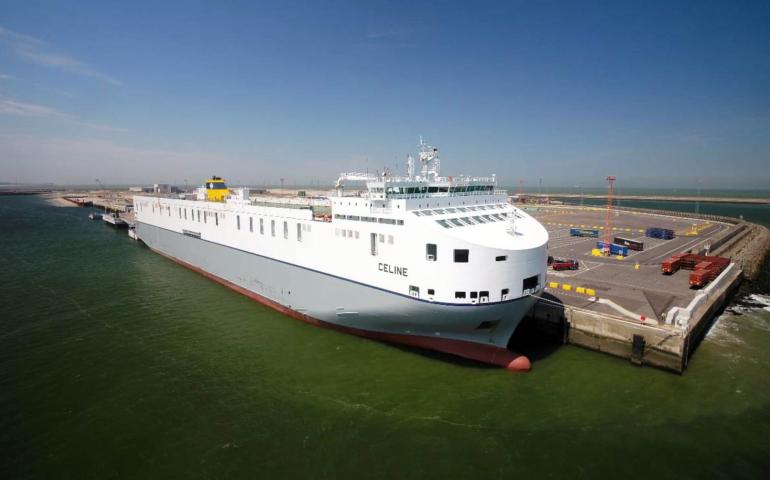
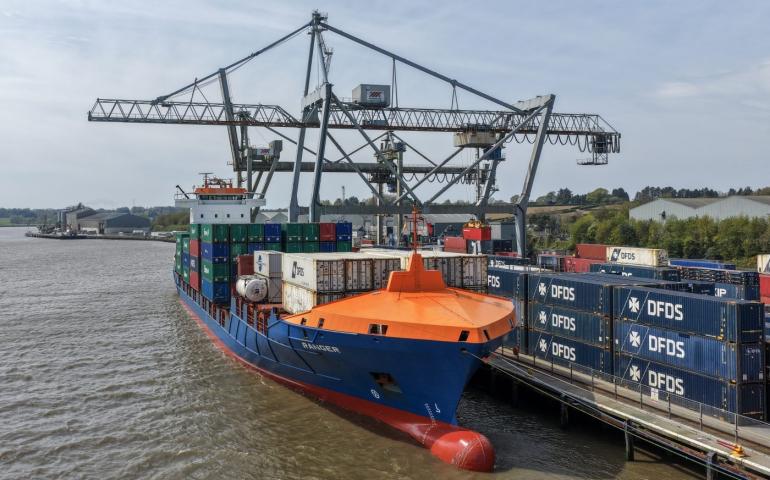
Docked container ship

The Irish maritime industry faced a series of global challenges in 2023. Prices rose sharply across large economies, suppressing consumption at home and abroad. In addition, the global energy transition continued to alter the makeup of raw materials arriving at Irish ports. As a result, both container and bulk traffic through Irish ports declined in 2023. But the industry remains resilient, and is facilitating robust Irish domestic demand in what was a year of challenging economic conditions. 

The issues facing the Irish shipping market in 2023 can be understood under the themes of inflation and energy transition.  Following a sharp rise in 2022, global inflation rates remained high in 2023. High inflation has suppressed demand for manufactured or consumer goods, such as those carried in containerised form, and this is evident in global seaborne trade volumes. World seaborne container trade grew by just 0.3% in 2023, which, excluding the impact of COVID-19, is the slowest rate of growth since the financial crisis of 2008. LoLo traffic through Republic of Ireland ports declined by 5% in 2023, while RoRo traffic fell by 2%. When converted, the volume of container traffic through Irish ports fell by approximately 3% in 2023.

In order to tackle these inflation rates, Central Banks in major economies swiftly raised interest rates which had the effect of slowing economic growth. 

Driven by these challenges, RoRo and LoLo volumes at Irish ports underperformed in 2023 relative to their long term trend, and underlying growth in both sectors is currently flat. That is not surprising, given the difficult economic environment within which Irish importers and exporters have traded in recent years, a period which includes COVID-19, Brexit, the Russian invasion of Ukraine and steep increases in energy prices. When these challenges are considered, the theme of unitised traffic at Irish ports becomes one of resilience. Both RoRo and LoLo traffic at Irish ports in 2023 is at almost exactly the level it was in 2019. In addition, Irish traders are connected to a greater number of mainland European ports than ever before, as post-Brexit capacity has become more diverse. Given the challenges faced in the intervening years, that is a remarkable performance and testament to the durability and adaptability of the Irish ports and shipping networks.

The decline in total Irish port tonnage in 2023 was also heavily influenced by dry bulk products, and this is indicative of the fact that as the Irish economy transitions away from fossil fuels, the composition of raw materials arriving at our ports will be reshaped. Dry bulk volumes, which are comprised of loose, non-containerised products for industrial or agricultural purposes, fell by 14% to its lowest total since 2010. The decline was driven in large part by two commodities: coal and fertiliser.

As reported by the Sustainable Energy Authority of Ireland (SEAI), 50% of Ireland’s electricity generation comes from pipelined natural gas, with a further 37% from wind energy. However, the movement of fossil fuels through Irish ports is likely to be replaced by other traffic, such as wind turbines and infrastructure related to battery technology, and this will be captured in cargo modes other than dry bulk. Irish port infrastructure will need to adapt to these changes in Irish energy generation in the coming years.

Liam Lacey, Director of the IMDO, commented: 

“The IMTE is a collaborative effort that relies on the support and confidence of industry stakeholders including the ports, shipping operators, industry bodies and the Department of Transport. The maritime transport sector is a success due to the vitally important work these stakeholders do. Maritime transport is the lifeblood of Irish trade, responsible for 90% of all goods transported internationally. The sector underpins growth, efficiency and competitiveness in our economy and 2023 was another year of uninterrupted access to international markets through our ports and shipping services.  The sector’s record of meeting and overcoming significant challenges instils confidence.  We look forward to working with all stakeholders to ensure that our maritime industry continues to serve the existing and future needs of the Irish economy.”


Thumbnail
Document's cover